Start with the delivery need
Discuss the customer commitment, the operating challenge and what is changing. Agree the value stream, people and constraints the work needs to cover.

The destination for the operating design
Design an operation where employees understand how work reaches the customer and can act when that flow is disrupted.
Operational Excellence is “when each and every employee can see the flow of value to the customer, and fix that flow before it breaks down.”
Kevin Duggan’s definition connects the design of the operation to what people can see and do in their daily work.
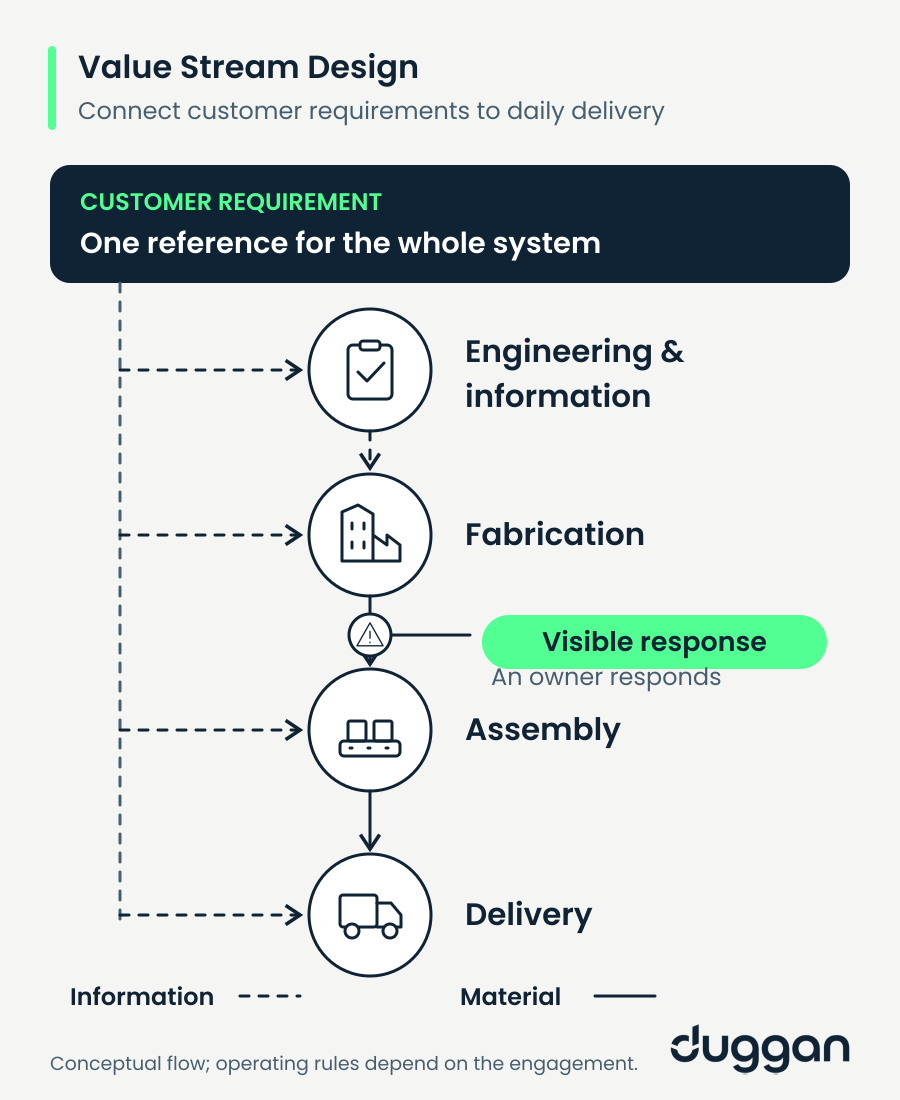
Discuss the customer commitment, the operating challenge and what is changing. Agree the value stream, people and constraints the work needs to cover.
Use product families, demand, routes and capability to define how work should move. Make expected flow, disruptions and responses visible.
Turn the design into an action plan, practical education and on-site support. Agree measures and responsibilities so the operation can sustain the change.
Understand what should move next and whether delivery is on time.
Use defined responses and escalate issues beyond the agreed authority.
Reduce repeated intervention so leaders can develop customers, products and new opportunities.
Define how value should move to the customer.
Put the designed connections into operation.
Make timing and the expected condition visible.
Define how the connections operate day to day.
Make disruptions recognizable when they emerge.
Define responses to disrupted conditions.
Build ownership and learning into daily work.
Use leadership time to develop customers, products and growth.
Product families, demand, routes and shared-resource capability shape the design. The same destination applies to manufacturing and office flows, while the detailed guidelines reflect the work involved.
Education explains why the connections work. Implementation gives people the opportunity to use the signals, standards and responses in their own operation.
Define the future-state connections and operating rules.
Explore Value Stream Design →Combine education and practical implementation support.
Explore Lean Consulting →Read specific engagement accounts and their reported outcomes.
Explore case studies →
How education, flow design and implementation create capability that stays in the operation.
Read the article →
A practical definition of Operational Excellence, from visible flow to leadership time for growth.
Read the article →
How reliable operating flow can create room for innovation, customer development and business growth.
Read the article →Use visible connections and response standards to identify disruption before it reaches the customer.
Explore the starting point →An industrial quoting operation reported 30% more quotes per day and 75% less processing time.
Read the case →IDEX’s published account connects visible flow with reduced supervisor firefighting at a specific site.
Read the case →No. Start with the delivery problem or business opportunity. Duggan can help define whether the starting point is flow design, a facility change, implementation support or an immediate operations leadership need.
Describe what customers need, where delivery becomes difficult and the change you want to achieve. Existing demand, lead-time or performance information is useful; the initial conversation can also identify what needs to be understood.
The scope may focus on delivery reliability, lead time, throughput, readiness or leadership capacity. Agree the baseline and measures for your operation. Case studies show specific results and design outputs, rather than a standard promise for every engagement.
Tell us where delivery is under pressure, what is changing and the outcome you are seeking. Use the client enquiry form below to start the conversation.
Call Duggan