Maintenance, repair and overhaul

MRO consulting for more predictable turnaround

Late parts, engineering queries and findings during inspection can disrupt a detailed maintenance plan. Duggan connects readiness, execution and support-shop flow so the operation can see constraints earlier and respond with a defined plan.

What makes the Duggan approach different

Design the maintenance system around the work

The main maintenance flow and its supporting functions form one Customer Delivery System. Task sequence, readiness and response requirements connect to the asset’s delivery commitment.

Give uncertainty an operating response

Recurring findings can inform planned work. New findings need assessment, authorization and a route for material, skills and decisions. The design makes the effect on the remaining sequence visible.

Connect support-shop commitments

Component repair, inspection and engineering queues affect work at the asset. Defined turnaround requirements and visible connections help support functions respond to the maintenance need.

Teach the people who will run it

Technicians and leaders learn the expected flow, how to recognize disruption and which response they own. Technical decisions and release authority remain with the maintenance organization.

Engagement examples across maintenance environments

Aircraft checks

26.5 → 18.5 days

Reported C-check lead time in an anonymized aircraft maintenance engagement: approximately 30% lower after connecting readiness, hangar execution and support shops.

Marine service

27% more inspections

Reported year-over-year inspection throughput in an anonymized marine service engagement, supported by connected planning, visual execution and clearer task readiness.

Rail overhaul

150 → 90 days

Reported power-car overhaul lead time: 40% lower. Technician effort also fell from 6,000 to 4,000 hours per overhaul; hours and elapsed days are separate measures.

Reported in Duggan’s anonymized engagement accounts. These are different maintenance scopes and are not a universal improvement guarantee.

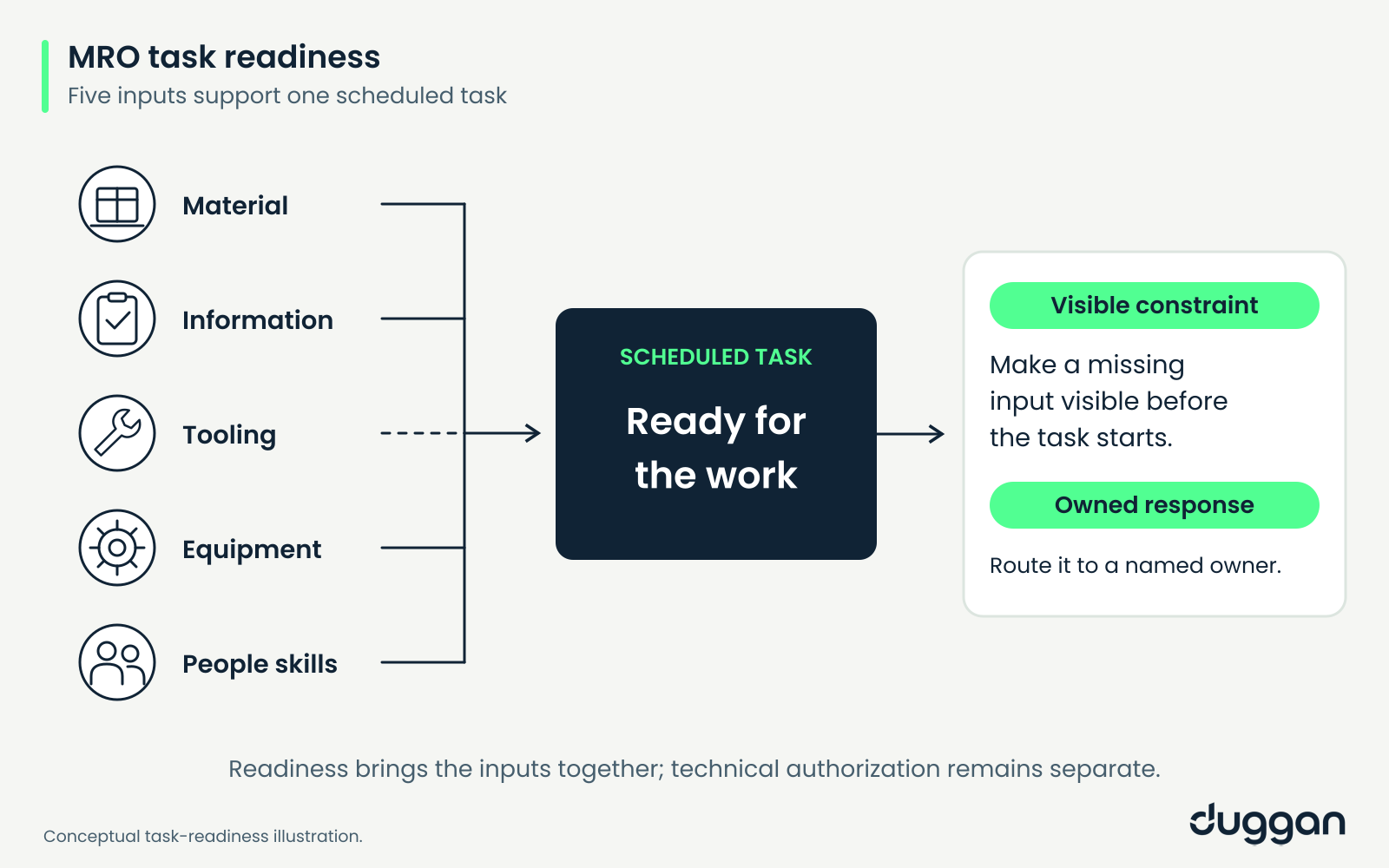
Five flows need to meet at the task

Material

Parts and consumables ready for the work.

Information

Current instructions, scope and authorized decisions.

Tooling

The right tools, available where needed.

Equipment

Suitable equipment and available capability.

People skills

The required skills and authorized capability.

Each input has its own preparation path. Connecting their readiness to the task helps expose constraints before they interrupt maintenance.

Material, information, tooling, equipment and people skills support a scheduled maintenance task; missing inputs receive an owned response.

From the first conversation to daily operation

  1. Define the first scope

    Agree the maintenance family, current performance and support dependencies. Establish comparable baseline measures.

  2. Design the connections

    Define readiness, execution and support flows, including assessment and response routes for work arising.

  3. Put the design into practice

    Educate the workforce, establish visible controls and agree implementation ownership and support.

  4. Review and extend

    Assess repeated comparable events, exceptions and operating responses before planning wider deployment.

What the engagement can include

  • Maintenance-family and current-flow assessment with agreed baseline measures.
  • Future-state design connecting maintenance execution, support shops and information.
  • Readiness and work-release arrangements that reflect actual maintenance constraints.
  • Visual execution controls and responses for normal and disrupted flow.
  • Practical education, implementation planning and on-site support.
  • Operating requirements for existing planning and digital systems.

The proposal defines the deliverables, responsibilities and support cadence. A defined pilot can provide a starting point for wider deployment.

A published aircraft maintenance example

Engagement example

Aircraft maintenance: connect the check with its support shops

The published case links maintenance readiness, visual execution and support-shop turnaround to aircraft checks.

The case reports a 30% reduction in C-check turnaround on the pilot line. It is an engagement-specific result.

Read the case study →

Examples relate to the stated engagements. Outcomes depend on the starting conditions, scope and implementation.

Practical capability in the maintenance operation

“Their focus on high participation built strong buy-in and a common language across the shop floor.”

SVP of Transformation & Technology, SIA Engineering Company — published testimonial

Make digital systems serve the flow

Planning and maintenance systems can support readiness, work status and decision timing. Duggan defines the operating requirements so digital changes reinforce the flow. New software development, integrations and ongoing IT support are separately defined with the responsible technology specialists.

Questions about the engagement

Can the design work when a clean start is impossible?

Readiness is an early-warning process. Where induction must proceed with unresolved inputs, the design makes exceptions, ownership and recovery needs explicit. It does not override mandatory maintenance or technical requirements.

How do you handle work discovered during inspection?

Distinguish recurring findings from genuinely uncertain scope. Connect technical assessment and authorization to material, skills and the remaining sequence. Significant changes may require revised delivery expectations.

What does Guaranteed Turnaround Time mean?

GTT is a defined turnaround commitment within the operating design. Work families, capability and operating assumptions must support it, with a response to exceptions. It is not a promise of the same percentage improvement for every engagement.

Does every task run to a fixed production-line rhythm?

No. Maintenance tasks vary in work content, dependencies and skills. The execution sequence and review cadence reflect that variation.

Do you support industries beyond aviation?

The approach applies to maintenance and overhaul settings including rail and marine work. The scope reflects the asset, support functions and requirements of the specific maintenance organization.

How long does an engagement take?

Timing depends on the maintenance family, support dependencies, available information and implementation scope. Design, pilot deployment and wider rollout are agreed as separate phases where appropriate.

What should we share in the first conversation?

The equipment or maintenance family, turnaround performance, recurring interruptions, support-shop constraints and any target dates are useful starting points. You do not need a complete data pack to make an initial enquiry.

Let’s discuss the flow behind your turnaround time

Tell us what you maintain, where work waits and the customer commitment under pressure.

The first conversation helps establish the operating need and the right next step. Use the enquiry form below, or call +1 (401) 667-7299.

Let's talk about
your MRO challenge.

Let's talk about
your challenge.