

The short answer
Operational Excellence can improve delivery and release operating capacity. Its broader purpose is to reduce repeated management intervention so leaders can spend more time developing customers, products and growth. Benefits depend on the operating design, implementation and commercial decisions that follow.
Improve delivery by making flow visible
Operational Excellence connects how work moves with what people can see and do. Defined flow, visual status and standard responses help employees identify disruption and act before it affects the customer.
Depending on the starting point and implementation, this can support shorter lead times, more dependable delivery, lower work-in-process and better use of capacity. These are outcomes to measure for the operation, rather than automatic benefits of adopting a label.
Create leadership capacity for growth
When managers spend less time expediting routine work, they can focus more on customers, new products and market opportunities. Duggan calls these Offense activities.
The connection is practical: an operating system reduces repeated intervention, and leadership deliberately uses that released capacity for business development. Growth also depends on customer demand, commercial choices and execution outside the operating design.
See the benefits in specific engagements
- Industrial quoting: the published account reports 30% more quotes per day and 75% less processing time after flow redesign. The scope is quoting, not overall plant productivity.
- IDEX Health & Science: the account describes supervisor firefighting falling from three to four hours per day to around 30 minutes at a specific site.
- Aircraft MRO: a long-haul C-check pilot reported a 30% reduction in turnaround time.
These are historical, engagement-specific results. They illustrate different measures of progress and should not be combined into a standard forecast for another business.
Choose measures that reflect the customer need
Start with the commitment the operation must deliver. Agree a baseline, the relevant product or service family and how performance will be measured. Make the distinction between a completed design, an implementation milestone and an achieved result explicit.
- Delivery: lead time and reliability against the customer commitment.
- Flow: queues, readiness, work-in-process and recurring disruptions.
- Capacity: throughput or work completed within the agreed scope.
- Leadership: time spent expediting versus customer and innovation work.
What an engagement needs to produce
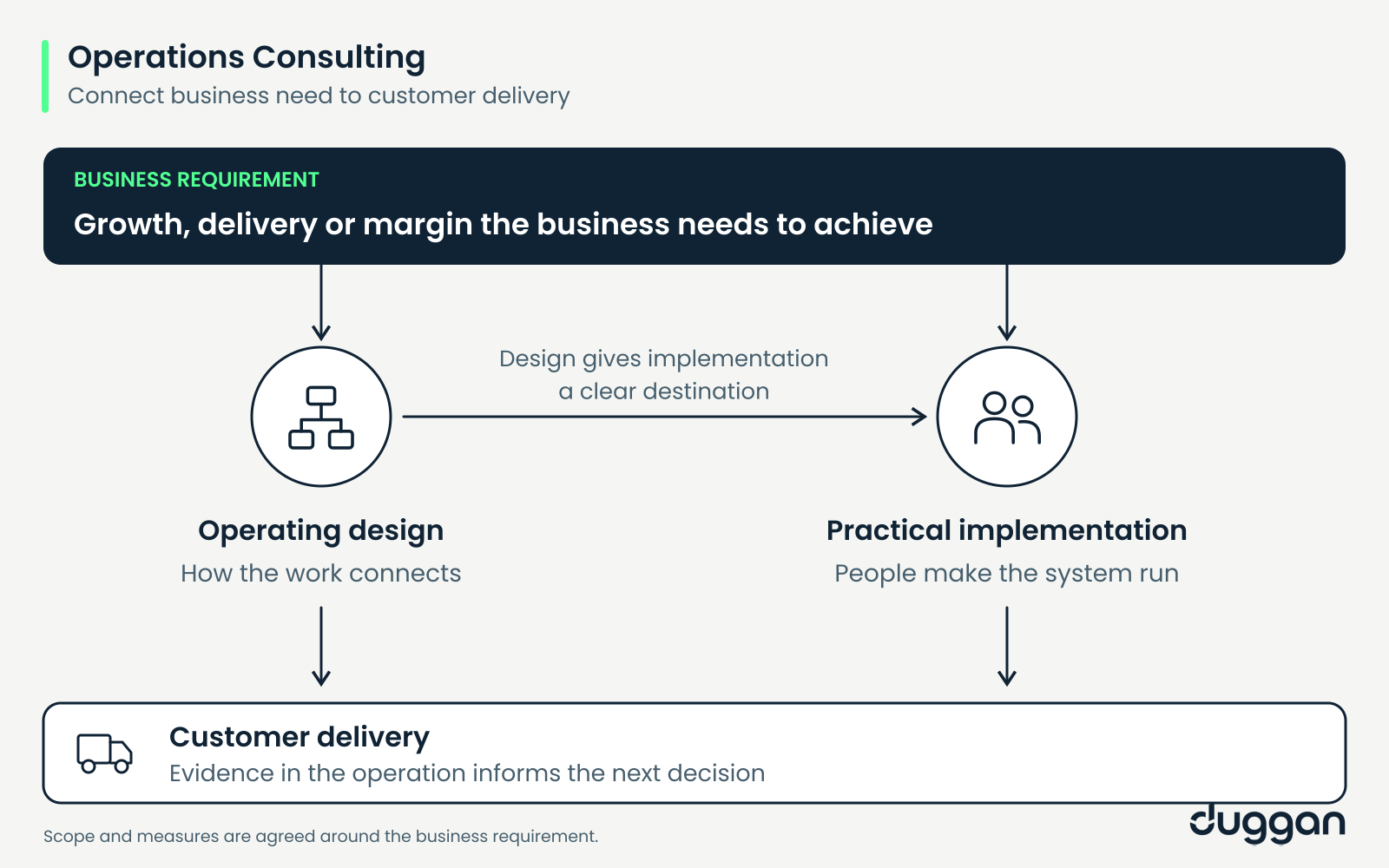
The work should connect a defined future-state flow with education, implementation responsibilities and measures. The practical outcome is an operating design people can understand and use, together with the capability to sustain and improve it.
Apply this to your operation
Agree both operating measures and how released leadership capacity will be used. Shorter lead time and more time for customer development answer different parts of the business case.
Explore the relevant Duggan service →