

The short answer
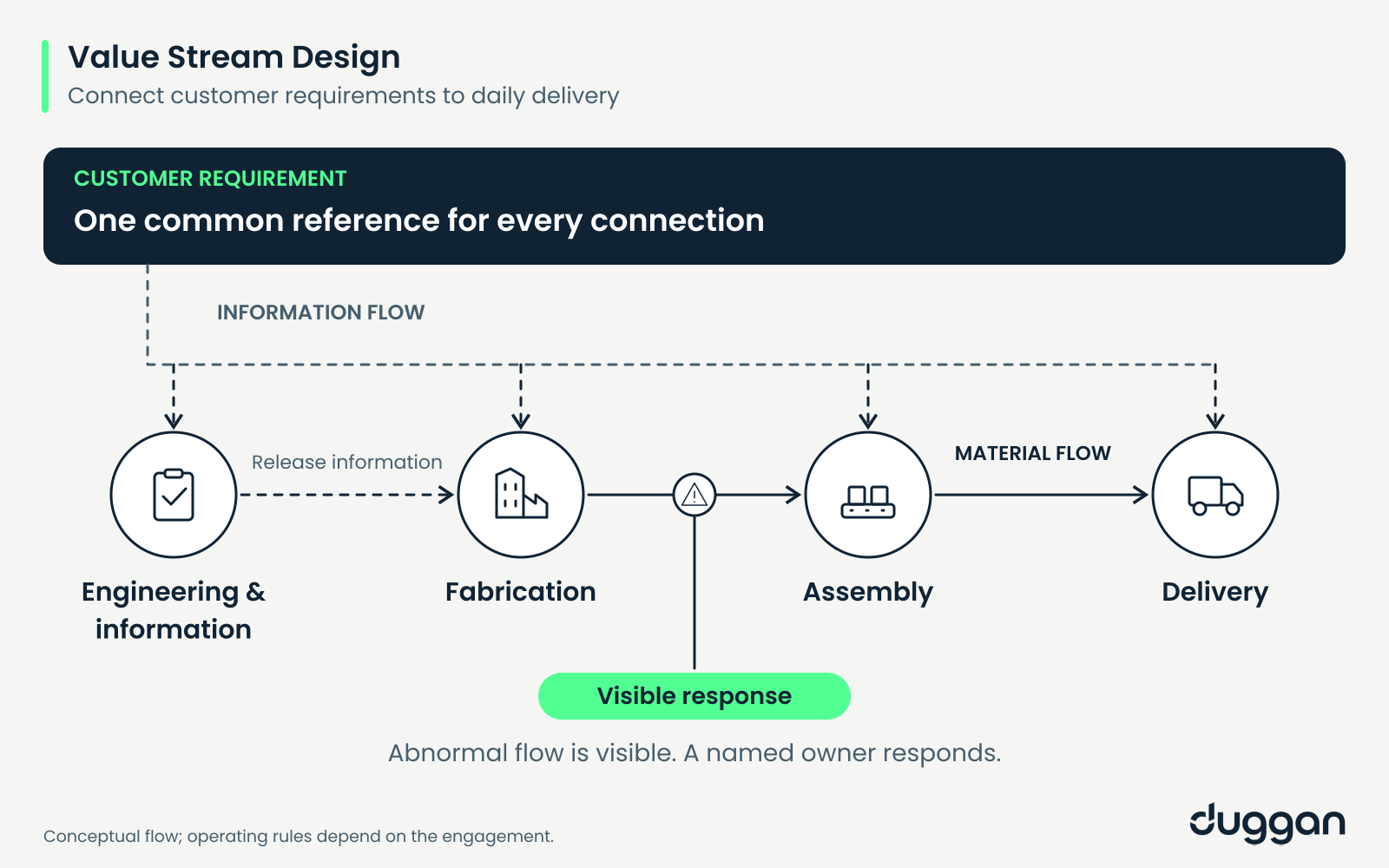
Operational Excellence makes flow visible and actionable. Employees understand how value reaches the customer, recognize when that flow is disrupted and use defined responses. The business purpose is to create capacity for customers, innovation and growth.
Understanding the method
Operational Excellence is not easy to define. Some descriptions are too broad. Others set parameters so narrow that the ultimate definition seems too focused in scope. Often, we end up with definitions that seem plausible in an academic sense, such as “Being world class,” “Being the best globally,” or, “Excellence in everything we do,” but are difficult to translate into practical actions. Worse yet, we end up with so many different interpretations of what “Operational Excellence” is that the organization as a whole lacks a precise definition and a roadmap to follow for achieving it.
To properly define Operational Excellence, we first need to ask some tough, fundamental questions about the nature of continuous improvement, the most important of which centers around a misconception regarding the purpose of continuous improvement itself.
We often hear that continuous improvement is a never-ending journey, and that by embracing the journey in and of itself, we will improve the operation forever. However, by setting the goal of perpetual improvement to make the operation more efficient, we may incrementally reduce cost, but there is no guarantee that our business will grow. What good is an efficient factory if the customer no longer needs our product?
To leverage operations to achieve business growth, the first step is to understand what Operational Excellence really is, and then how we achieve it. Think of it as answering the question: “Where will our journey of continuous improvement take us?” A good answer is that our journey will take us to Operational Excellence, or the point at which
Each and every employee can see the flow of value to the customer, and fix that flow before it breaks down.SM
While this definition may seem simple, it is in this simplicity that the magic lies.
By defining Operational Excellence in this way, it applies to every level and every person in the organization, from executives all the way down to the employees producing the product. It’s clear, concise, practical and, most importantly, actionable and teachable. Everyone in the organization “gets it.” They know that, in their respective areas, there should be a visible flow of product or information. They should be able to recognize if that flow is normal or abnormal and what to do if it is abnormal, all without requiring the assistance of management.
With this definition of Operational Excellence, we can begin to teach the true power of lean value streams by taking them a step further. We can now create value streams that not only flow at the rate of customer demand, but are made visual in such a way and to such a degree that every employee in the organization can physically see that flow.
We have all heard of the visual factory, but this is different. We are not talking about identifying where tools, equipment, processes, and departments are located. Rather, in Operational Excellence, visuals are strictly for the timing of flow. And these visuals are easy to understand by anyone, to the point where a visitor can come into our operation and tell us if we are on-time without asking any questions, requesting any reports, or looking at any computer printouts. The intent is to make the operation so visual that every employee can see the flow of value to the customer and tell if this flow is normal or abnormal.
Once everyone can see normal and abnormal flow, the next step is to create what’s known as standard work for abnormal flow. In this phase, we create standard work that corrects when abnormal conditions in the flow begin to occur. This means that the people working in the flow (either on the manufacturing floor or in the office) have a standard methodology for correcting things when they go wrong. The end result is something called “self-healing” value streams, which means that when flow breaks down somewhere in the operation, the employees working in the flow are able to fix it using defined responses, with escalation when needed.
This last phrase is a critical feature, since once we achieve Operational Excellence, we can reduce routine management intervention in day-to-day flow. Instead, operations leadership can spend their time working with sales and the innovation process to develop new products that customers want and that fit the operation’s capabilities. The result is time spent on activities that generate top-line growth.
The key to success in achieving Operational Excellence starts with the right definition, one that everyone, at all levels of the operation, can understand and know how to achieve. That way, each employee will see that our continuous improvement efforts are not about eliminating waste or lowering cost. Rather, the end goal is to have operations be a key player in creating and delivering products that customers want in order to establish perpetual business growth.
Apply this to your operation
Start with one customer delivery path. Can people see what should happen next, whether it is on time and what response is expected when it is not?
Explore the relevant Duggan service →