Manufacturing services

Connect engineering, fabrication and assembly around customer delivery

High-mix manufacturing needs flow that accommodates different routes, work content and customer requirements. Duggan helps design those connections and supports the workforce as the design becomes daily practice.

Busy processes can still leave orders waiting

Engineering

Engineering releases arrive late

Fabrication, assembly and test are left with less time to meet the customer commitment.

Assembly readiness

Inventory is in the wrong place

Plenty of work in process does not mean assembly has the complete set it needs.

Shared resources

Batch economics drive priorities

Large batches can protect an apparent unit cost while increasing queues and delaying other orders.

Scheduling

The schedule keeps changing

Expediting alters priorities without resolving the connections that made work late.

What makes the Duggan approach different

Mixed-model flow for the products you make

Product families group work by the processes and capability it needs. Duggan’s mixed-model methods connect demand, work content and sequencing so variety is an input to the design.

Shared resources connected to downstream needs

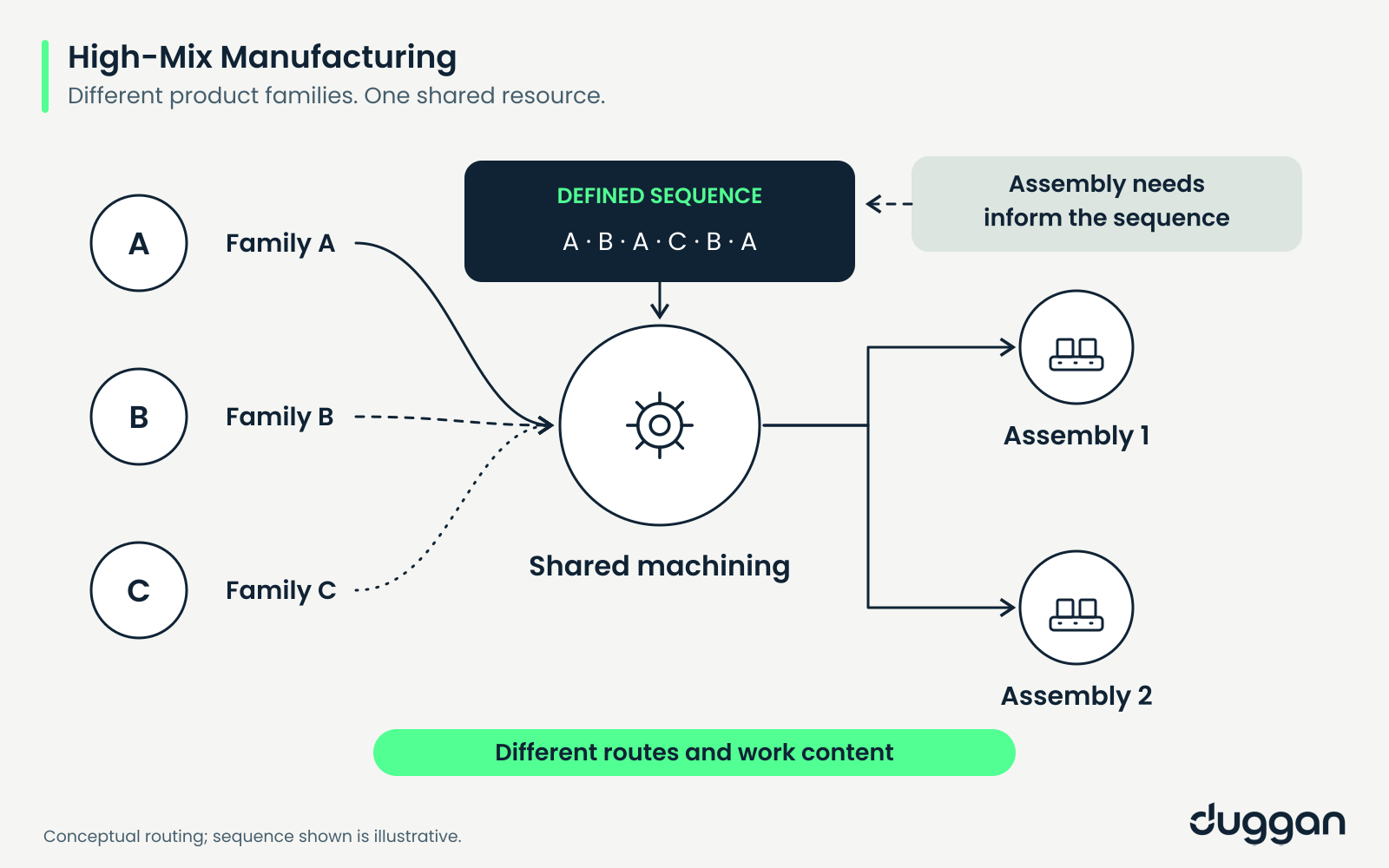
A machine or fabrication process may serve several value streams. Flow through Shared Resources connects that work with the needs of assembly, using defined sequencing and turnaround requirements.

A defined scheduling point

The pacemaker is the process at which the value stream’s schedule is set. Its position and connections help preserve sequence and reduce repeated scheduling at individual processes.

Design knowledge carried into implementation

Practical education and on-site support help people understand why the connections matter. Changes during deployment can then be assessed against the intended flow and customer commitment.

What an engagement can produce

  • Product Family Matrix and future-state Value Stream Design.
  • Future-state facility layout where physical changes are needed.
  • Implementation plan linking actions, responsibilities and sequence.
  • Mixed-model and shared-resource flow training.
  • Implementation support and regular progress reporting.

From product families to working flow

  1. Scope the operation

    Discuss customer needs, product mix and constraints. A scoping visit informs the proposal where appropriate.

  2. Design the future state

    Build the Product Family Matrix and define flow, sequencing and shared-resource connections.

  3. Prepare the changes

    Use layout design and 3P where required. Teach the methods the workforce will implement.

  4. Support implementation

    Work alongside the workforce to resolve practical issues while preserving the intended operating design.

Product families share machining capacity through a defined sequence informed by downstream assembly needs.

Stay connected through implementation

Duggan can add implementation capacity through Senior Associates and Operations Engineers. Support is tailored to the pace of change and the work your operation can absorb, from periodic coaching to more intensive on-site involvement. Responsibilities and availability are agreed in the scope.

Duggan recommends continued support as the design is implemented. This helps the workforce make practical decisions without losing the connections the future state depends on.

Examples from Duggan engagements

Engagement example

Pump manufacturing: put mixed-model assembly into flow

Duggan connected assembly, paint and shipping using flow design, practical handling changes and visible execution.

Early output reached 15 units per day from a baseline of 12. The 21-per-day figure was a target, not the reported achieved result.

Read the case study →

Engagement example

Hypertherm: make flow visible across a high-mix operation

Duggan’s published account describes connected receiving, fabrication, assembly and shipping, with visual signals and standard responses.

The account describes less daily management intervention and leadership attention redirected to customers and new products.

Read the case study →

Examples relate to the stated engagements. Outcomes depend on the starting conditions, scope and implementation.

Reliable delivery creates room for growth

When people can see work moving and respond to interruptions, fewer daily decisions need to return to management. Operational Excellence creates capacity for leadership to work on customers, new products and growth—what Duggan calls working on Offense.

For operations leaders

Connect priorities, handoffs and responses around the customer commitment. Assess progress through delivery, lead time, work in process and recurring interruptions.

For business leaders

Understand what the operation can support as demand, product mix or capacity needs change. Use that clarity to make growth and investment decisions.

Frequently asked questions

Does every product need the same route?

No. Routes, work content and demand inform product families and the design of shared resources.

Is a plant relayout always needed?

No. Physical layout changes are considered where the flow design requires them and are scoped accordingly.

How long will the work take?

Timing depends on the number of value streams, complexity and implementation support. Agree the design and deployment phases during scoping.

Can the project start with one value stream?

A defined value stream can be a starting scope. Its connections to shared processes and supporting functions still need to be considered.

Let’s discuss what needs to change

Tell us where engineering, fabrication or assembly loses time, and which customer commitments are affected.

Use the enquiry form below to start the conversation.

Let’s talk about your complex machine and fabrication shops challenge.

Let's talk about
your challenge.