
A fabrication department can be meeting its output target while assembly waits for one missing component. Engineering may release work in a sequence that leaves production little time to respond. The schedule changes again, and teams protect themselves by building more inventory.
Each department is working hard. Yet the customer is still waiting. The useful question is what happens between the processes: how work is released, how priorities are chosen and whether the next operation has what it needs.
Follow a product family through the operation
Start with the path work follows: the processes it needs, the resources it shares and the information that authorizes it to move. Product families make that path understandable without treating every part number as a separate operating system.
Products that look similar may require different processes or substantially different amounts of work. Conversely, products sold into different markets may follow a similar route through production. Understanding those relationships helps establish which products can share an operating design.
In engineer-to-order work, engineering decisions and releases belong in the analysis too. A late or incomplete release changes the time available for fabrication, assembly and test. A production-only map can leave that dependency outside the design.
For a worked example of grouping products by process route and work content, see Product Family Analysis.
Inventory quantity does not establish readiness
Consider an assembly waiting for a machined part. The machine shop has a large queue, and many completed parts are available. If the required part is absent, neither the queue nor the total inventory figure tells assembly when it can complete the order.
Ask which product family the missing part belongs to, when it is needed downstream and how the shared resource selects its next job. Also check whether the information, tooling and people needed to perform the work are ready.
These questions reveal the difference between having stock and having the right work ready to progress. Adding inventory without changing the release and sequencing rules can leave the original delivery problem intact.
Design the connections around shared equipment
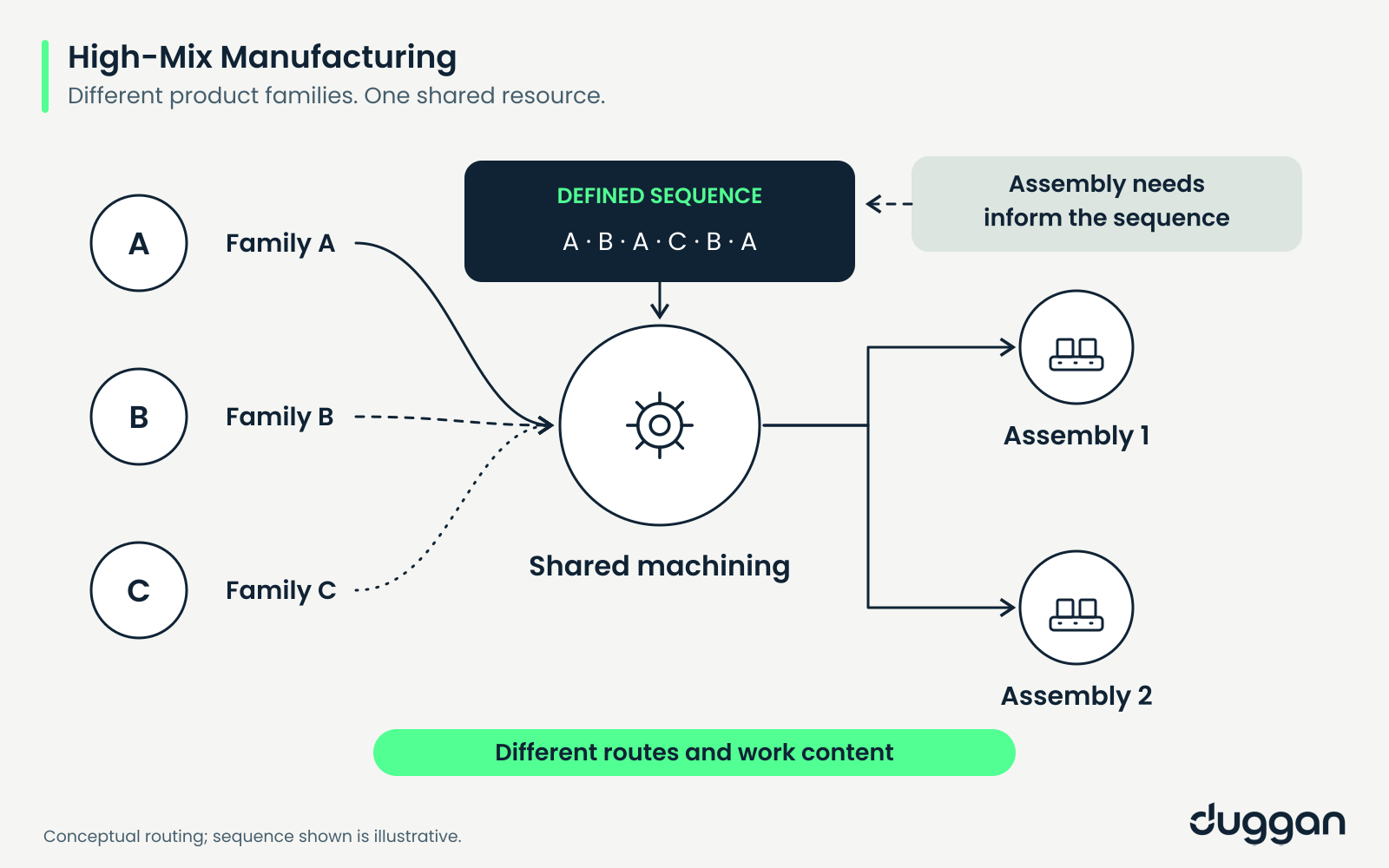
Machining, fabrication, paint or test may serve several product families. Each family needs a dependable connection to those resources, even when the resource cannot be dedicated to one value stream.
The design needs to make three decisions explicit: what work can enter the shared process, how the next item is selected, and how downstream operations know when to expect it. Where appropriate, a defined Guaranteed Turnaround Time gives the shared process a clear delivery commitment under agreed operating conditions.
Sequencing rules, FIFO lanes and limits on work in process need to reflect demand, processing capability and the mix of work. They also need an agreed response when the operation moves outside those conditions. A queue that is visible but has no response rule still leaves the team dependent on expediting.
Evaluate batch decisions across the whole flow
A larger batch can look attractive when the measure is cost per unit at one machine. Its effect on downstream waiting, available capacity and the mix of inventory also matters. Those consequences need to be evaluated together.
The question is not whether every batch should be the same size or whether all batching should disappear. It is how the operating design accommodates setup requirements and demand while supporting predictable customer delivery.
Look at how frequently the shared process can return to each product family. Shortening that interval may improve responsiveness, but it must be supported by realistic setup times, available capacity and operating rules. A schedule that assumes unavailable capability will soon become another expediting list.
Make the response to disruption part of the design
A future-state drawing is a starting point. Teams also need to know what normal flow looks like, what signals a problem and what action to take next.
That includes clear ownership when a queue reaches its limit, a promised turnaround is at risk or engineering information is incomplete. Some problems can be corrected at the point of work; others need an agreed escalation. The aim is an understandable response that does not depend on a manager rediscovering the problem each day.
Training, operating rules and implementation support help the team apply the design when real constraints emerge. Progress should be checked against customer delivery, not just completion of individual improvement activities.
Start with a few late orders
A practical first discussion does not require a perfect dataset. Trace a few recent late orders from engineering or order release through fabrication, assembly and shipment.
- Where did each order wait, and what was it waiting for?
- Which resources were shared with other product families?
- Where did priorities change, and who made that decision?
- What signal could have exposed the risk earlier?
- What response was available before the promised delivery date was missed?
Then use consistent measures—order lead time, on-time delivery, work in process and recurring schedule changes—to judge whether the whole flow is becoming more dependable.
As the operation becomes easier to see and run, leaders have a stronger basis for supporting growth without relying on continual expediting.
See the approach in practice
Hypertherm’s case study explores the relationship between visible flow, employee capability and growth. The pump manufacturing case study shows why connecting assembly, paint and shipping matters to the overall result.
For engagement options, explore High-Mix Manufacturing Flow or Value Stream Design.