
The challenge: expand without reproducing the same constraints
A large industrial manufacturer planned a major expansion to meet increasing demand. Outdated layouts, siloed operations and poor visibility across value streams meant that additional space risked reproducing existing inefficiencies.
Leadership engaged Duggan to embed Operational Excellence into the expansion from the outset.
- Assembly and fabrication were arranged for convenience rather than flow.
- Weak FIFO control in material handling and warehousing created congestion and delays.
- Facility-design decisions lacked a standard process, increasing execution risk and cost.
- The workforce needed education in abnormal flow and corrective action.
Engagement at a glance
Future-state design
Completed layout connecting production, warehousing and support.
20–30% potential
Lead-time reduction identified; projected, pending implementation.
Phased roadmap
Expansion planned around continuing production.
What Duggan did: connect seven areas of operating design
Duggan assessed the operation across the site and designed a future-state facility layout around lean and Operational Excellence principles.
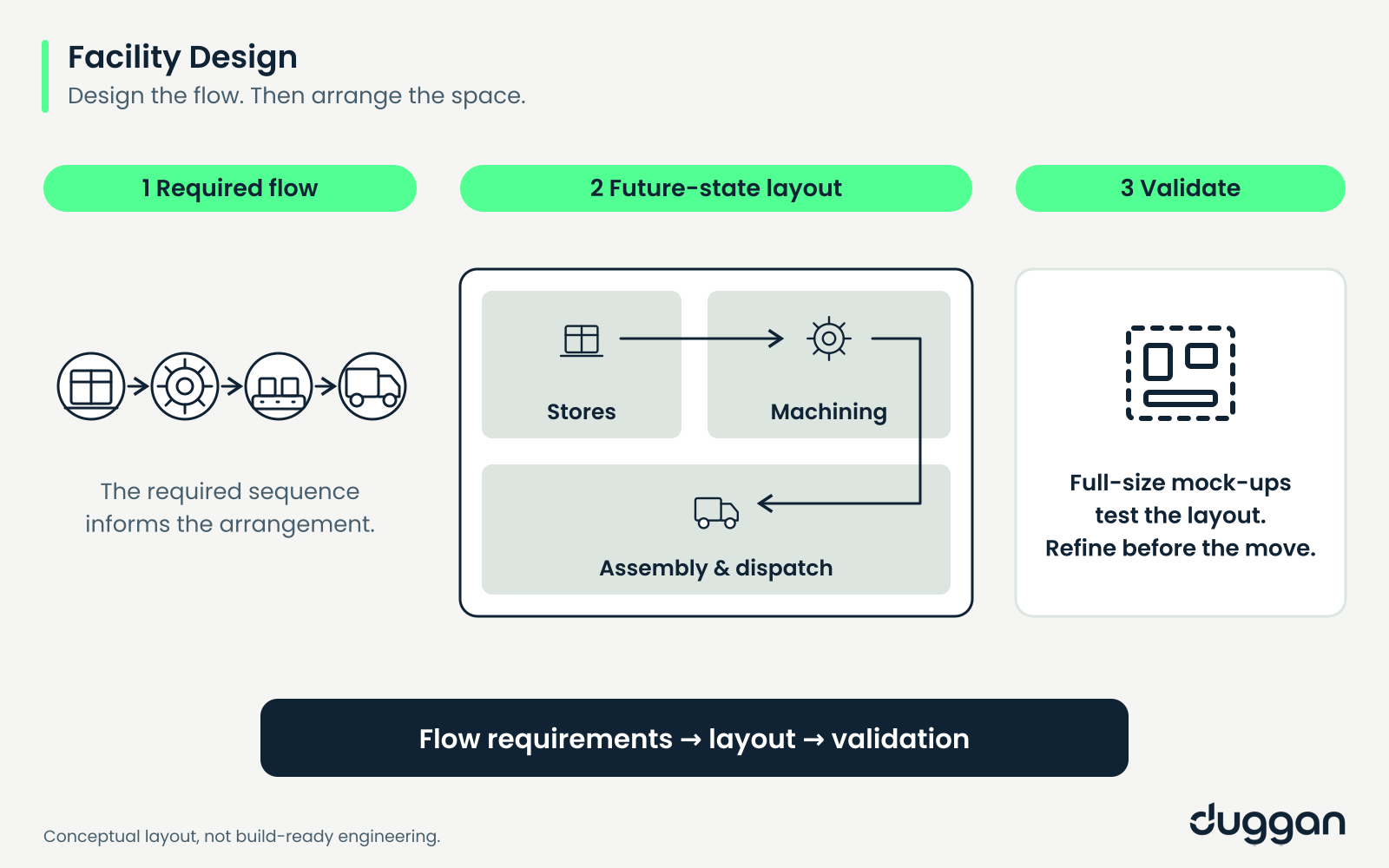
- Facility Design: layouts that supported end-to-end flow, material presentation, kitting zones and line-of-sight between processes.
- Value Stream Design: product families, Guaranteed Turnaround Times and visible connections from fabrication to assembly.
- Complex Machine Fabrication: equipment cells aligned with flow logic instead of functional silos.
- Large Stationary Assemblies: assembly bays mapped around takt-based sequencing and space requirements.
- 5S: organized workspaces supported by visual standards.
- MRO: lean principles applied to maintenance and repair to reduce downtime and strengthen reliability.
- Lean Consulting: education, flow-disruption walks and standard work to build workforce capability.
Implementation: a master layout and a practical transition
- Developed a master facility layout aligning production flow, warehouse operations and support functions, including Engineering.
- Introduced visual management boards and kitting standards to streamline material delivery.
- Ran design workshops with leadership, engineering and operators to validate the proposed layouts.
- Created a phased implementation roadmap that balanced the expansion with ongoing production.
- Embedded Operational Excellence principles into the facility-design process itself, giving future changes a disciplined method.
Results to date: design completed, opportunity defined
The future-state facility design was completed, aligning functions around predictable flow.
The work identified opportunities for 20–30% lead-time reduction through layout changes, single-point scheduling and improved material handling. These were projected benefits pending execution.
Workforce exposure to Operational Excellence supported early adoption of 5S and flow-disruption walks. Full implementation was not completed, so the full operating benefits were not realized. The design and roadmap established the groundwork for subsequent execution.
Why the design approach mattered
An end-to-end view
The facility was designed as a connected system rather than a collection of separate departments.
Flow before layout
Value-stream requirements drove the layout decisions, giving the physical arrangement a clear operating purpose.
Education and ownership
Teams learned to recognize and respond to flow problems so the new design could become a system they understood and owned.
A scalable method
The initial work gave leadership a roadmap and a repeatable framework for extending Operational Excellence across sites and future facility changes.