
Facility design outcomes
We Design Facilities to Fuel Business Growth and Grab Market Share
We do much more than a layout. We design a Customer Delivery System built to support business growth.
Your new facility plus our new approach equals growth
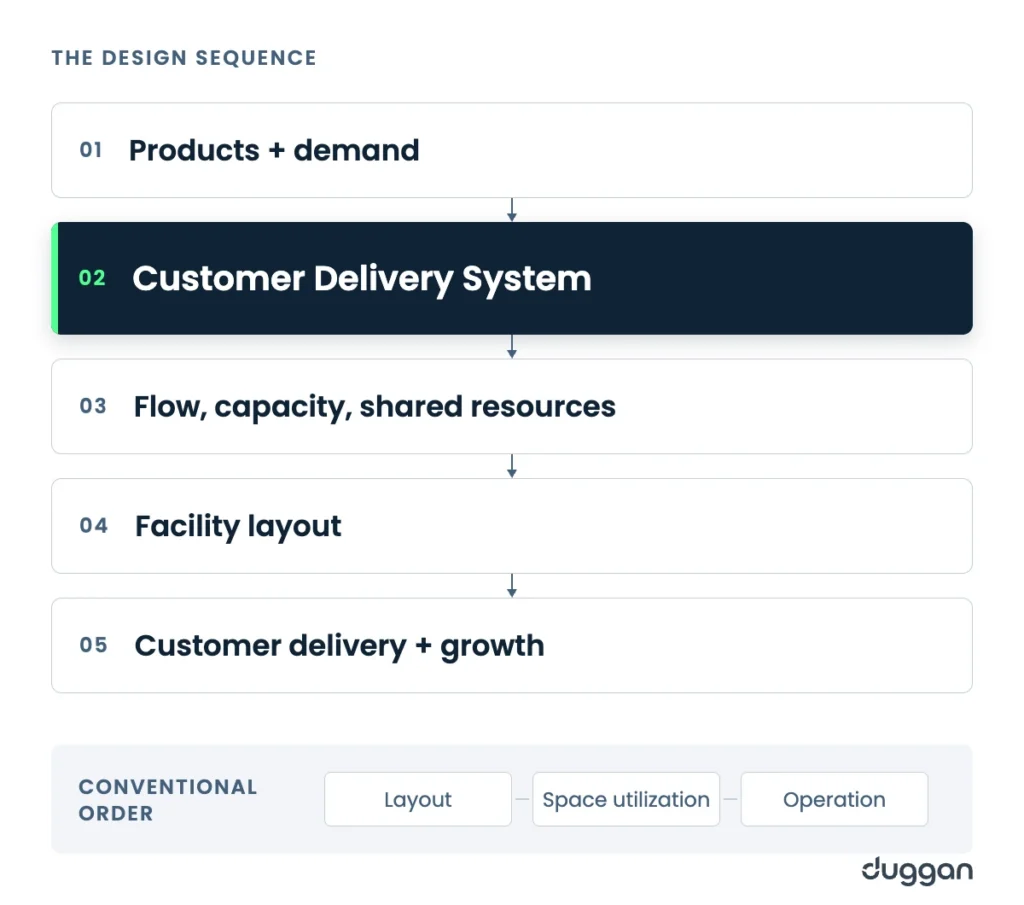
Traditional facility design often centers on layout and space utilization. An efficient-looking layout can reduce travel distance, walking and infrastructure cost, and those are real gains.
Duggan starts somewhere else. The first question is how the operation will deliver products or services to its customers. Product mix and demand are understood before the layout is finalized.
Duggan Facility Design creates a Customer Delivery System capable of delivering a high mix of products at the rate of customer demand. Relevant design principles include Mixed Model Production, creating flow through shared resources, the five critical flows for large equipment builds, and information flow in the office.
The Customer Delivery System is designed first. Layouts are then created to support that system and to use the space efficiently. The intended end state is a more autonomous operation that depends less on daily management intervention.
Why we are different
Three design enablers connect the new facility to customer delivery and business growth.
01 — End-to-end process
The design begins with the end-to-end process
When an organization is consolidating, expanding, relocating or building a new facility, Duggan begins with the end-to-end process required to deliver products to the customer — from customer order, through manufacturing, to delivery.
This matters most where flow is genuinely complex:
- High-mix manufacturing, where many products share the same processes.
- High customization, where few orders look alike.
- Engineer-to-order, where design work sits inside the delivery path.
- Large equipment builds, where several flows must converge at the right moment.
- Operations with shared resources, where a single constraint serves many product families.
The method is math-based rather than judgement-based. It determines the resources required, the capacity needed, and the strategies for handling changing demand. The operating process is embedded into the facility design rather than added to it afterwards.
The result is more than a layout. It is an operating system with a building around it.

02 — Customer-focused culture
A facility move is an opportunity to align culture with customer delivery
The facility design should make customer delivery understandable to the people performing the work. That begins with the questions an operator faces during an ordinary shift:
- How will each operator know what to work on next?
- Where does the work come from?
- How will they know if they are on time?
- How much should be produced?
- Who receives it next?
- When should it move?
- When is a changeover required?
A Customer Delivery System designed to answer these questions in the physical environment lets employees understand their role in customer delivery, what comes next, whether flow is normal, whether flow is abnormal, and whether customer delivery is at risk.
This is more than a visual factory. A tidy workspace and a board of last month's results do not show whether today's commitments are on track. The design makes the current condition of delivery readable where the work happens.
A visitor should be able to see whether customer delivery is on time. If a visitor can see it, every employee can see it.

03 — Leaders work on offense
The true growth benefit is leadership capacity
A designed Customer Delivery System reduces the time leaders spend chasing parts, chasing people, resolving resource conflicts and intervening in daily problems.
Leaders first support the end-to-end operating process and teach the workforce how the flow works. As daily management intervention falls, leadership time becomes available for the work that grows the business.
-
Daily management muscle
- Expediting
- Chasing parts and people
- Reprioritizing
- Resolving conflicts
- Status meetings
-
Designed Customer Delivery System
- Visible flow
- Normal and abnormal conditions
- Standard response
- Predictable handoffs
-
Offense
- Product development
- New customer services
- Distribution opportunities
- Customer experience
- Revenue growth
Management does not disappear. Its attention moves from keeping ordinary flow running to the decisions that only leadership can make.
The facility is the physical expression of the Customer Delivery System
- The building itself is not the operating system.
- The layout supports the designed flow.
- Flow supports customer delivery.
- The Customer Delivery System reduces the need for daily management intervention.
- Freed leadership capacity can be redirected to Offense.
Designing in that order is what connects a facility project to business growth rather than to square footage.
Frequently asked questions
How can facility design support business growth?
Facility design can support growth when capacity, product mix, customer demand, shared resources and end-to-end flow are designed before the physical layout is finalized.
What is a Customer Delivery System?
It is the designed end-to-end operating system that allows employees to see how value flows to the customer, distinguish normal from abnormal flow, and respond before delivery is affected.
Why does Duggan design flow before the layout?
Because the physical layout should support the way products, information, people and resources must flow to meet customer demand. Designing the space first can hard-code constraints into the operation.
What does “working on Offense” mean?
Activities that grow the business — customers, products, services, channels and market opportunities — rather than management time consumed running daily operations.
Designing, expanding or relocating a facility?
The earlier the Customer Delivery System is designed, the more the facility can do for the business. Tell us what is changing, which products or services are affected, and what the operation needs to achieve.