The challenge: an operation that could support growth
Privately held Hypertherm, based in Hanover, New Hampshire, designs and builds advanced plasma-cutting systems on a vertically integrated, high-mix campus. Early use of lean tools was not the central constraint. Leadership wanted an operation that grew the business without relying on daily management heroics.
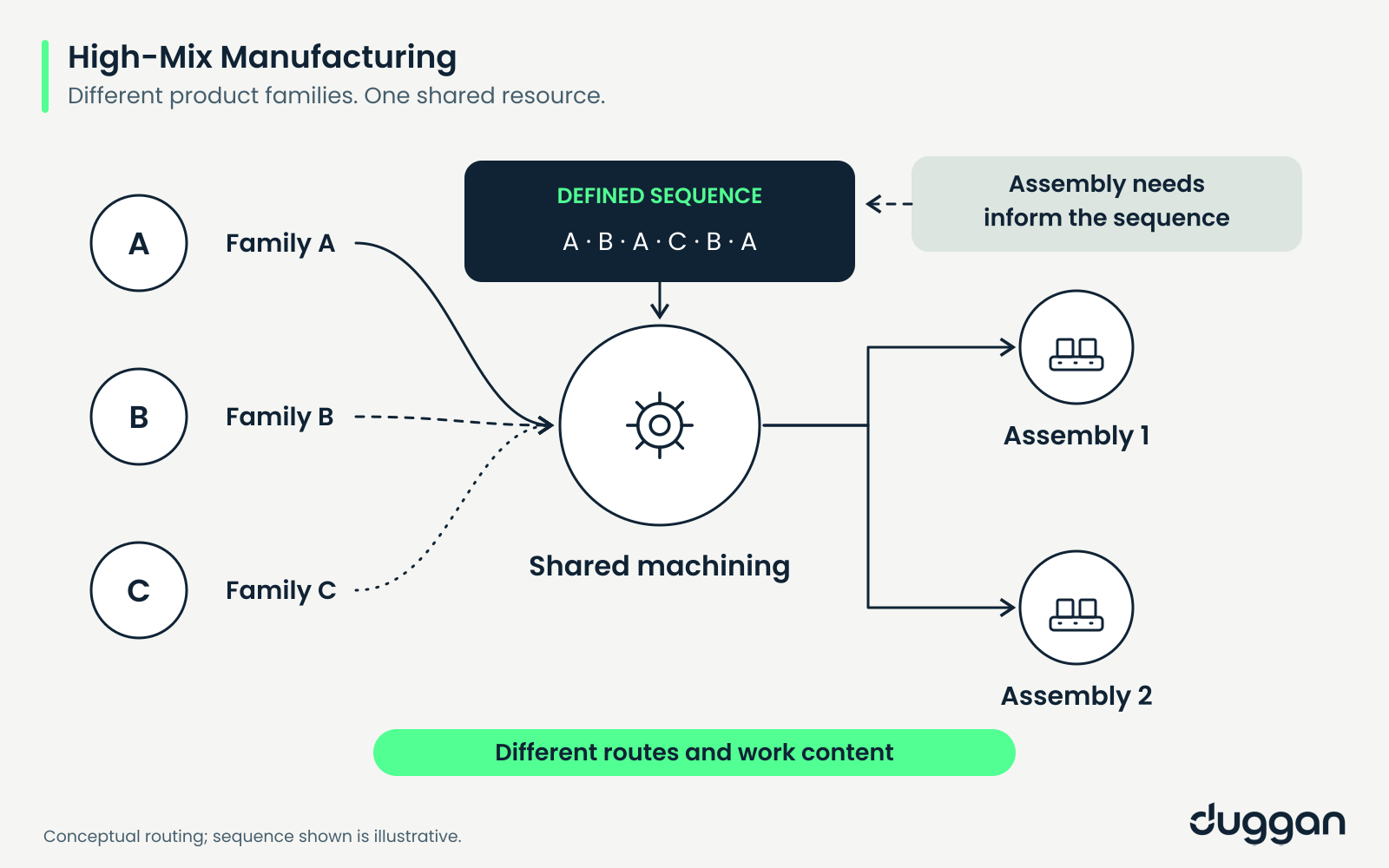
- End-to-end flow had to connect shared machining, assembly and test without central production control.
- A tight local labor market constrained access to skilled CNC operators.
- Electronics supply-chain fragility and recessionary demand shocks tested resilience.
- The company’s no-layoff people philosophy needed to hold through those downturns.
Engagement at a glance
7×
Sales growth over five years in the period described.
10 weeks
Full-time CNC training cohorts through HTTI.
More leadership capacity
Less daily operating intervention; greater focus on customers and new products.
What Duggan did: design flow that associates could run
The value-stream operating system enabled associates to see flow directly and correct abnormal conditions at the source.
- Connected receiving, fabrication, assembly and shipping. Green, yellow and red “thermometer boards,” FIFO lanes and standard responses made normal and abnormal flow visible.
- Moved work authorization to the floor. Central production control was removed, with visible operating signals guiding execution.
- Connected market signals to operations. The office was reorganized into product-line business teams combining Operations, R&D and Sales/Marketing.
- Strengthened supplier connections. More frequent deliveries were triggered by signals. Shop-floor associates helped design line-ready kitting and crates.
Implementation: people, office flow and resilience
Self-healing value streams
Associates initiated defined fixes at the source, keeping flow on time without waiting for routine meetings and approvals.
Office flow by design
Cross-functional business teams accelerated decisions and reduced repeated rescheduling. The structure connected customer and market needs with operating execution.
People first through downturns
The no-layoff approach retained capability when demand fell. Available capacity was redeployed into continuous improvement, laboratory and testing work, and insourced facilities work—accelerating improvement rather than losing skills.
A technical capability engine
The broader operating model supported the establishment of the Hypertherm Technical Training Institute (HTTI). Ten-week, full-time cohorts developed CNC talent, fed machining capability, shortened development loops and freed engineers for product and technology work. Autonomous maintenance strengthened equipment ownership.
Results: growth, resilience and leadership capacity
Across the business and the periods described, Hypertherm’s operating model combined flow, people development, supplier relationships and market-facing decisions.
- Sales grew sevenfold over five years. Following external economic shocks, the business returned to previous peaks roughly a year ahead of plan.
- Investment continued through a steep downturn. With revenue down 36%, R&D investment rose 20%, more products were launched than in any prior year, and profit-sharing payments continued.
- Post-recession growth was roughly twice that of public peers. Production moved to 24 hours a day, five days a week, with additional weekend shifts.
- New Hampshire served global demand. Some 25% of output went to Asia and 30% to Europe, with minimal pipeline inventory.
- Leadership time shifted toward growth. Less daily intervention enabled leaders to concentrate on customers, strategy and new products.
Why it worked
Flow before tools
Clearly defined normal and abnormal flows, visual control and standard responses made operating status actionable at the point of work.
Associate ownership
Skills, trust and shared rewards supported fast local problem-solving and innovation.
Close connections between markets and operations
The business-team structure and HTTI linked operating reliability with customer needs and future capability. Flow was part of a wider growth model, with commercial decisions and people development reinforcing the operational work.